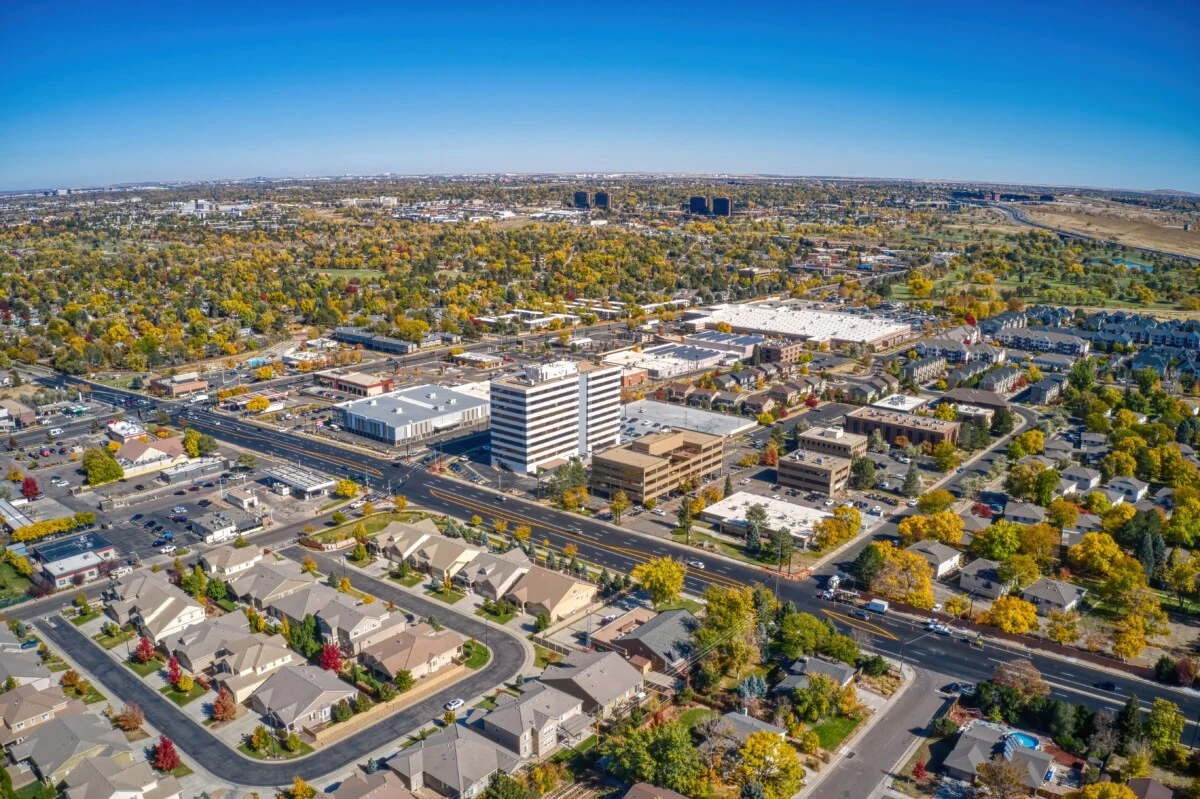
Commercial Roofers in Green Valley Ranch
Commercial roofing in Green Valley Ranch should begin with a documented assessment of membrane condition, seams, flashings, drainage, penetrations, and moisture before repair, coating, or replacement is selected. Green Valley Ranch sits in the final approach miles to Denver International Airport, and the roofs along Tower Road and E-470 reflect that: hotel product built for occupancy turnover, retail pads built fast to catch airport and residential traffic, and almost none of it more than twenty-five years old. Commercial Roofers of Aurora prices these roofs against real numbers, membrane thickness, hail impact class, and the cost of a property that cannot close during a review period or a holiday travel week.
Hotel Roofs That Can't Go Dark
The hospitality cluster serving DIA travelers runs low-slope membrane over occupied rooms, meeting rooms, and back-of-house kitchens, which means every square foot of roof work happens over a building that is still selling rooms. We scope hotel reroofs in sections, moving from one wing to the next so housekeeping and front-desk operations never see more than a partial closure of guest floors below. Noise and odor control matter here in a way they do not on a vacant warehouse. A hot-applied modified bitumen kettle running during a Tuesday morning meeting block is a problem for the general manager, so we sequence hot work around the property's own booking calendar where we can.
Hotel roofs also carry more penetrations per square foot than almost any other building type we roof: rooftop units for individual guest room zones, kitchen and laundry exhaust, elevator overrun curbs, and pool mechanical vents. Each penetration is a potential leak point, and on a property this age the flashing detail at those penetrations is usually the first thing to fail, well before the field membrane does.
Retail Pads Built for the DIA Boom
The retail centers along Tower Road and Picadilly Road went up to serve both Green Valley Ranch residents and the steady flow of airport-adjacent traffic, and most of it is single-story pre-engineered steel with mechanically fastened TPO over a low parapet. That construction type is inexpensive to build and inexpensive to reroof, but the low parapet height means wind uplift at the roof edge is a bigger factor here than it would be on a taller building, and the fastening pattern at the perimeter has to account for it.
Gas stations, quick-service pads, and drive-through buildings in this corridor tend to get reroofed on a shorter cycle than the anchor boxes around them, because the roof area is small enough that owners often defer the decision until a leak forces it. We price those small-footprint jobs the same way we price a 200,000-square-foot warehouse: itemized tear-off, insulation, membrane, and edge metal, so a five-figure job gets the same rigor as a six-figure one.
What Hail Alley Actually Costs a Roof Out Here
Denver's eastern suburbs sit inside one of the country's most active hail corridors, and Green Valley Ranch's flat, exposed prairie setting east of the city does not do the roof stock any favors. A single severe storm can hit every roof in this corridor the same week, which is exactly what has happened in past hail seasons along this stretch of E-470. We spec Class 4 impact-rated membrane and cap sheet on new installs and recovers wherever the budget allows it, because the incremental cost of impact resistance is small next to the cost of a full reroof five years early.
After a hail event, we document conditions with photos and, where the damage is ambiguous, a moisture scan, and we give the property manager a written scope before any insurance conversation starts. We do not promise a claim outcome, that is between the owner and the carrier, but we do provide the documentation that supports whatever decision gets made.
A post-storm roof walk on a hail-alley property typically covers:
- Granule loss and bruising on the field membrane or cap sheet
- Punctures and splits around fasteners and seams
- Dented edge metal, coping, and gravel stops
- Cracked pipe boots and pitch pans
- Denting and fin damage on rooftop condenser and RTU coils
- Compromised skylight and roof hatch seals
- Bent or clogged gutters, scuppers, and downspout heads
Wind Loading and Elevation on the Open Prairie
East of Denver International, there is little to break the wind before it reaches a roof, and design wind speeds for this exposure category run higher than they would on a shielded infill lot closer to downtown. We spec FM-approved fastening patterns and uplift ratings to that exposure, not to a generic citywide default, because a membrane rated for a sheltered site can fail at the perimeter on an open corridor like this one during a Front Range wind event.
At roughly 5,400 feet of elevation, UV exposure runs meaningfully higher than it does at sea level even on a cold day, which accelerates polymer degradation on thinner membranes. Combine that with the freeze-thaw cycling of a Denver winter, where a 60-degree afternoon can follow an overnight low in the teens, and seams and flashings take more stress cycles per year here than in most of the country.
Budgeting a Reroof Around a Booking Calendar
For hospitality clients, we build the schedule around occupancy data, not weather windows alone. Late winter and early spring, before the summer leisure and airport-connection travel season ramps up, is usually the lowest-disruption window for a hotel reroof in this corridor. For retail pads, we compare recover-over-existing against full tear-off up front, because a recover can save a tenant a lease-disruption closure if the existing insulation tests dry and the code allows it.
Every proposal breaks out the cost per square foot for each option over a 15- and 20-year horizon, so an owner comparing a cheaper recover against a more expensive full replacement can see which one actually costs less per year of service.
Questions From Green Valley Ranch Property Managers
Can you reroof a hotel without closing guest floors?
Yes. We section the work so only the floor or wing under the active work zone is affected, and we schedule hot work and heavy equipment moves around your booking calendar wherever possible.
Is Class 4 impact-rated membrane worth the extra cost here?
In most cases, yes. Given how often this corridor takes hail, the incremental cost of an impact-rated cap sheet or membrane is usually smaller than the cost of one early reroof after a bad storm season.
How quickly can you get someone out after a hailstorm?
We prioritize emergency tarp and dry-in calls after confirmed storm damage and schedule full inspections as soon as conditions allow safe roof access. Response time depends on storm scale across the corridor, since a widespread event affects many roofs at once.
Do you help with insurance documentation?
We provide photo documentation, scope of damage, and repair estimates that support your claim process. We do not represent the outcome of any claim, that determination sits with the carrier and adjuster.
Why do roofs near the airport corridor wear faster than roofs closer to downtown Denver?
Open prairie exposure means higher design wind loads and less shelter from hail than a roof tucked among taller buildings, and both factors add stress cycles to the membrane and flashings every year.