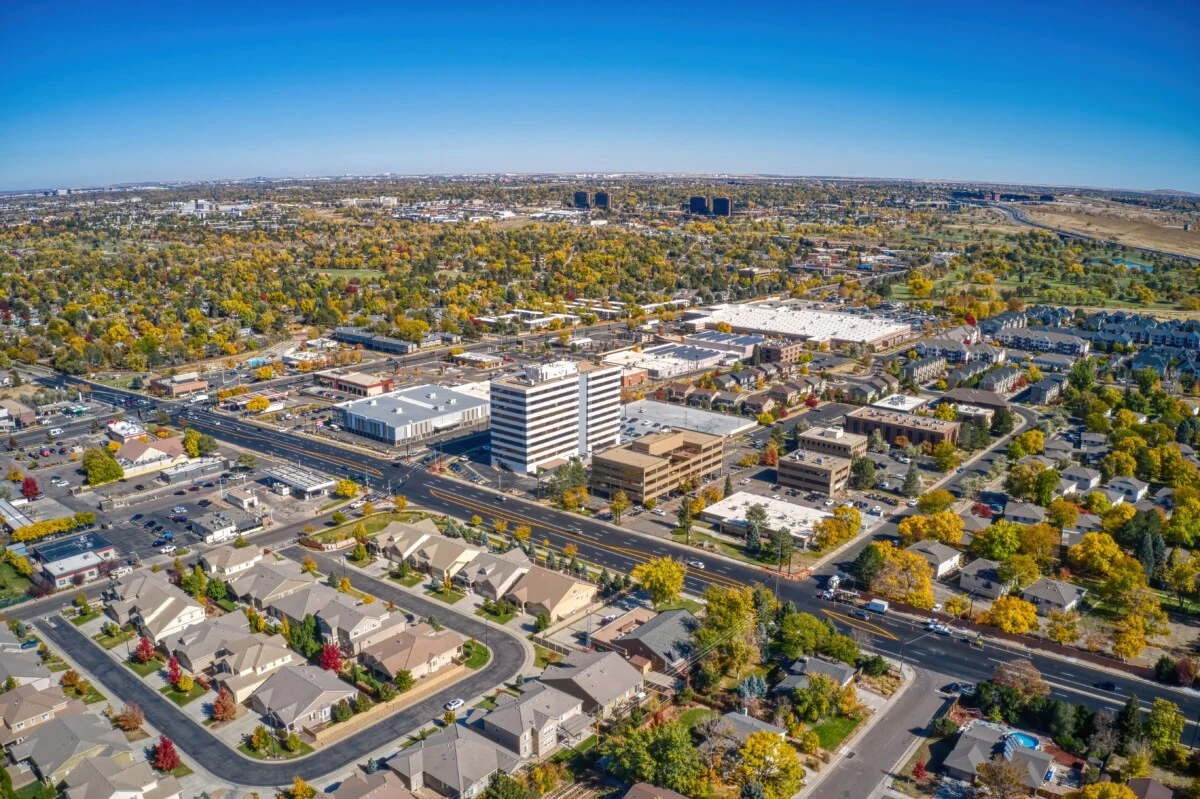
Commercial Roofers in Thornton, CO
Commercial roofing in Thornton, CO should begin with a documented assessment of membrane condition, seams, flashings, drainage, penetrations, and moisture before repair, coating, or replacement is selected. Thornton's commercial roof stock centers on the Larkridge shopping district, a growing run of medical office buildings, and pockets of light industrial space east of I-25. We estimate each type on the equipment density and traffic pattern that actually drives cost, not a flat per-square-foot rate across the whole city.
Larkridge's Big-Box Anchors
Larkridge carries the kind of large-format retail roof we see at similar power centers up and down the Front Range, wide-open TPO or modified bitumen fields over anchor stores, with rooftop HVAC concentrated near the building's mechanical core rather than spread evenly across the field. Inspection on a roof this size means working a grid pattern and logging every curb and drain individually, since a general walk-through misses too much on a field that can run past 100,000 square feet.
Recover timing on these anchors usually gets decided by curb flashing condition more than field membrane condition. Once several rooftop unit flashings start failing faster than the surrounding membrane, a full recover that resets every curb detail at once is typically the more cost-effective path than chasing individual leaks.
Medical Office Buildings Along the I-25 Corridor
Thornton's medical office growth has picked up along the I-25 frontage, and these buildings carry a different roof profile than the retail anchors nearby, smaller footprints, denser rooftop mechanical equipment relative to total roof area, and more sensitivity to noise and disruption during business hours since most run active patient scheduling five or six days a week. We sequence tear-off and mechanical work around clinic hours where we can, and we treat curb and pitch pocket detailing on these buildings as a bigger share of the labor estimate than the open-field membrane work.
Rooftop condenser units serving imaging equipment on some of these buildings also need cleaner drainage and structural support than a standard HVAC curb, since that equipment is expensive to replace if roof-level water intrusion reaches it.
Light Industrial Pockets East of I-25
Behind Thornton's retail and medical frontage, there's a scattering of smaller light industrial and flex buildings that get less regular attention from ownership than the higher-visibility properties nearby. We see more deferred maintenance in this pocket than anywhere else in Thornton, mostly because these buildings don't have a property management company running a standing inspection schedule the way a retail anchor or medical campus does.
A basic annual walk-through on these smaller industrial buildings catches flashing wear and fastener issues well before they become an interior leak, and it's a cheaper habit than waiting for a tenant complaint to trigger an emergency call late on a Friday afternoon.
Rooftop Unit Density on Suburban Medical Buildings
Medical office roofs in this corridor pack more HVAC tonnage per square foot than almost any other building type we work on in Thornton, since imaging equipment, specialized exam room climate control, and standard office HVAC all stack onto one roof. That density means more curbs, more pitch pockets, and more places for water to find a way in if a single detail is done wrong, so we treat curb count as its own line item on the estimate rather than folding it into a blended field rate.
- Big-box and grocery-anchored retail at Larkridge
- Medical and specialty clinic office buildings along I-25
- Light industrial and flex space east of the interstate
- Multi-tenant strip retail along 128th and Colorado Boulevard
- Municipal and school district facilities
- Self-storage and light warehouse buildings
Storm Season Along Thornton's Open Frontage
Thornton sits inside the same Front Range hail corridor as the rest of the Denver metro, and its larger flat retail and industrial roofs take that exposure directly given how little windbreak the corridor offers. We inspect large roofs section by section after storms rather than spot-checking, since hail damage on a field this size is often inconsistent, heavier on one corner of a Larkridge anchor than across the rest of the field.
On medical office buildings specifically, we prioritize storm-response inspections given how quickly a compromised membrane over active clinic space can turn from a maintenance item into an operational problem that affects patient scheduling.
Thornton Roofing Questions From Property and Facility Managers
How do you inspect a roof as large as a Larkridge anchor store?
We work a grid pattern and log every curb, drain, and penetration individually rather than doing a general walk-through, since damage and wear on a field this size is rarely uniform.
Why do medical office roofs need more curb detailing than retail?
They pack more HVAC tonnage per square foot, including specialized equipment like imaging condensers, which means more penetrations and pitch pockets relative to the open field area.
Can roof work happen around an active medical clinic's hours?
In most cases, yes. We sequence the loudest work around clinic scheduling and treat that coordination as part of the project plan, not an afterthought.
Why do the light industrial buildings east of I-25 need more attention than expected?
Many don't have a property management company running a standing inspection schedule, so deferred maintenance shows up more often there than on Thornton's higher-visibility retail and medical properties.
How fast can you respond after a hailstorm hits Thornton?
We prioritize storm-response inspections for medical office buildings first given the operational stakes, then move through retail and industrial roofs, typically getting eyes on a roof within a few days of a significant event.