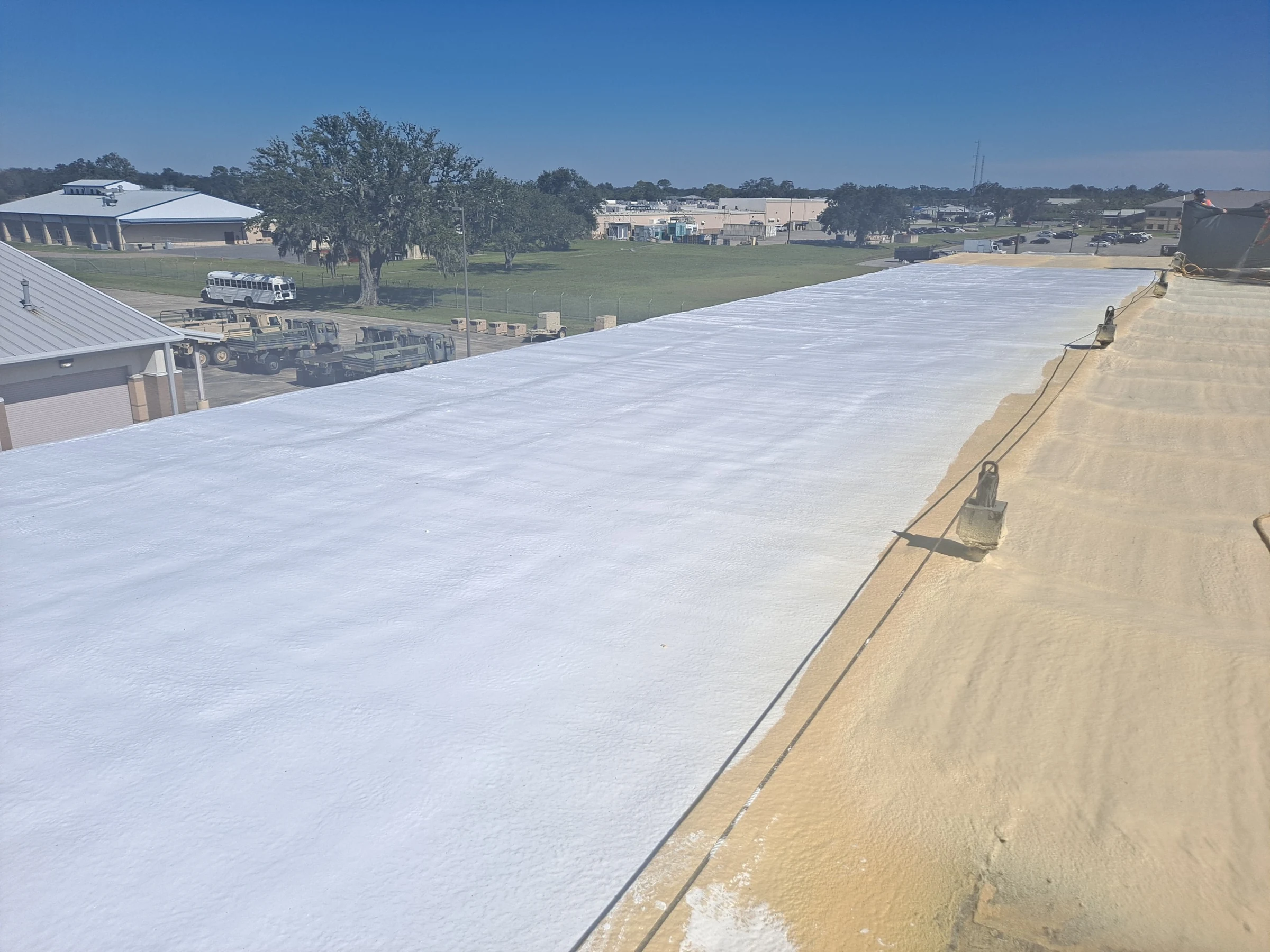
Spray Foam Retrofit for Irregular Roofs on the Eastern Plains
Spray polyurethane foam is the system we reach for on irregular roof geometry and retrofit jobs where a sheet membrane would fight the substrate every step of the way. Ag buildings, grain facilities, and older metal-panel structures out toward Bennett, Strasburg, and Byers are where SPF earns its spec most often.
A Self-Flashing, Monolithic Surface
Spray foam is applied as a liquid that expands and cures in place, which means it self-flashes around curbs, penetrations, and irregular deck transitions without the field-cut detail work a sheet membrane requires. On a retrofit over an old standing-seam or R-panel metal roof with dozens of fasteners, ribs, and old patch repairs, that monolithic application avoids trying to force a flat sheet material over a surface it was never designed to conform to.
Insulation Value Built Into the Roof Surface
SPF roofing carries genuine insulation value in the foam layer itself, which is a meaningful advantage on plains buildings with large uninsulated or under-insulated metal roofs. Given the daily temperature swings common on the eastern plains, insulating at the roof surface rather than adding interior insulation separately can materially change the building's heating and cooling load, particularly on ag and light-industrial buildings where interior insulation was never part of the original design.
Hail Exposure and the Topcoat
The foam layer itself is vulnerable to hail bruising if it is left under-protected, since cured foam can dent or crack under a direct hard-impact strike the way a bare sheet membrane would not. That is why SPF roofing is never left as bare foam: an elastomeric topcoat, typically with an embedded granule or aggregate surfacing, is applied over the cured foam specifically to add impact resistance and UV protection. We spec topcoat thickness and granule embedment based on the exposure profile for that address, since the plains east of Aurora see real hail activity during storm season same as the metro core.
Fully Adhered Means No Blow-Off Risk
Because SPF is fully adhered and monolithic across the entire roof surface, it does not have the loose-laid ballast or mechanically fastened seam edges that create wind-uplift failure points on other systems. On open plains sites with high sustained wind exposure, that full-surface adhesion is a genuine structural advantage over a mechanically attached membrane where fastener plates and seam edges are the failure points in a severe wind event.
- Retrofit over aging standing-seam or R-panel metal roofs
- Irregular deck geometry with heavy penetration counts
- Ag, grain, and light-industrial buildings on the eastern plains corridor
- Buildings needing added roof-surface insulation value without interior work
- Roofs where wind uplift resistance matters more than impact resistance alone
Application Window and the Freeze-Thaw Factor
Spray foam application is far more sensitive to weather conditions than sheet membrane installation. Surface temperature, dew point, and humidity all have to fall within a workable range for the foam to expand, cure, and bond correctly, which narrows our install windows on the plains where weather can shift fast during shoulder seasons. Freeze-thaw cycling matters less to SPF's in-service performance once the topcoat is cured than it does to the installation schedule itself; we plan spray days around the forecast, not the calendar.
Ongoing maintenance on an SPF roof means periodic topcoat recoating on a maintenance interval tied to UV exposure and wear, since the topcoat is what protects the foam layer over the life of the roof. That recoat cycle is a budget line owners need to plan for, not a one-time install cost.
Deck and Panel Prep Before Spraying
An old metal panel roof going into an SPF retrofit needs surface prep before foam ever gets sprayed: loose fasteners tightened or replaced, rusted panel sections treated or cut out, and standing water or debris cleared from panel ribs. Foam sprayed over a rusted or contaminated surface will not adhere the way it should, and that adhesion failure shows up later as blistering or delamination rather than an immediate problem on install day.
On grain and ag buildings out toward Strasburg and Byers, where roofs often go years between any close inspection, we budget time for this prep work as its own line item rather than folding it into the spray labor estimate, since the condition of an old panel roof is rarely known until we are actually up there walking it.
Spray Foam Roofing Questions
Can spray foam be applied over an existing metal roof without tear-off?
In most cases, yes, which is a major reason it gets specified for retrofit jobs. We confirm the existing panel and fastener condition first.
Does spray foam roofing need to be recoated over time?
Yes. The elastomeric topcoat protecting the foam needs periodic recoating on an interval tied to UV exposure and wear, and that is a planned maintenance cost.
Is spray foam vulnerable to hail damage?
The foam itself can bruise under direct impact if left unprotected, which is why an impact-resistant granulated topcoat is always part of the system, not an optional add-on.
Why does spray foam application depend so much on weather?
Surface temperature, dew point, and humidity all affect how the foam expands and cures. We schedule spray days based on forecast conditions rather than a fixed calendar date.
Is spray foam a good fit for a building with irregular roof geometry?
Yes, that is one of its strongest use cases. The self-flashing, monolithic application handles irregular curbs and penetrations better than sheet membrane systems.