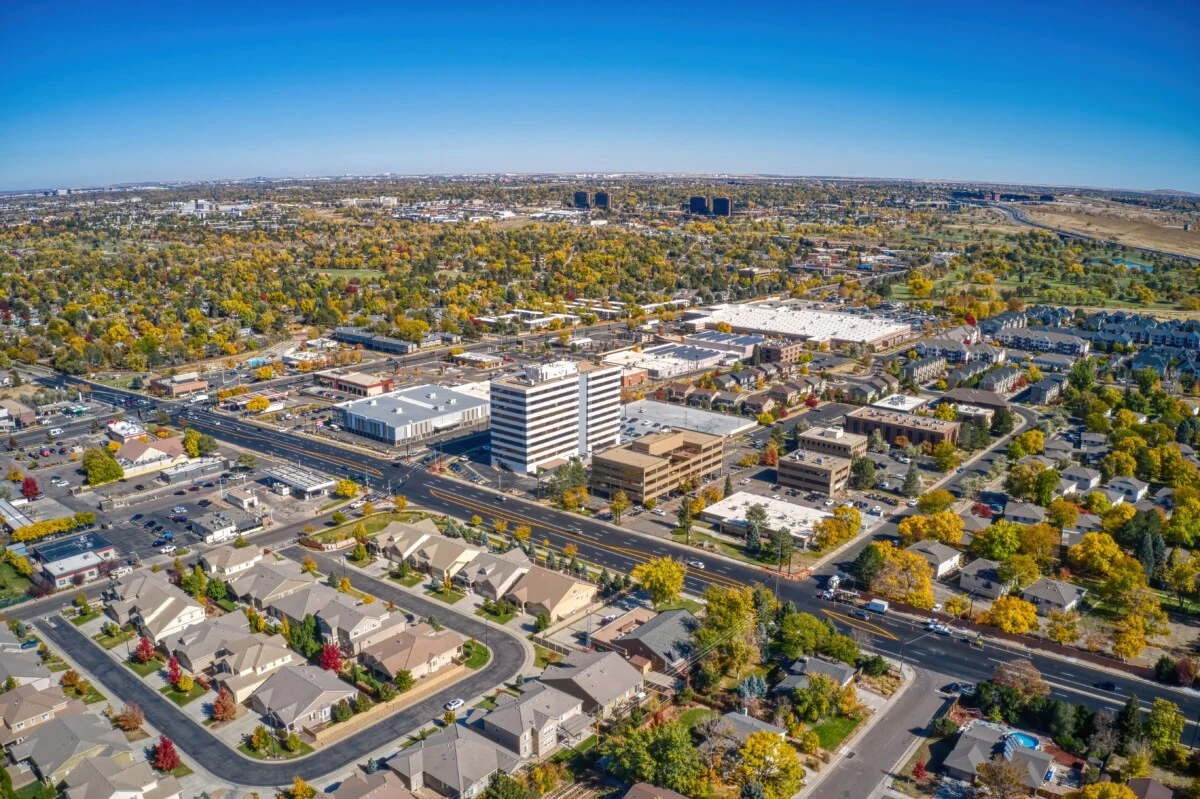
Commercial Roofers in Dove Valley
Commercial roofers serving Dove Valley should document leak sources, wet insulation, drainage, edge details, penetrations, and repair history before recommending a scope. Dove Valley grew up as a newer south-metro business park, and its roof stock reflects that: steel deck flex-industrial buildings with mechanically fastened TPO, and larger corporate campus buildings with heavier rooftop mechanical loads than a typical flex building carries. Commercial Roofers of Aurora prices both building types the same way, itemized scope, membrane comparison, and a real number for lifecycle cost per square foot.
Flex-Industrial Construction Along Peoria and Dry Creek
Most of the flex product in Dove Valley is single-story pre-engineered steel with a shallow parapet and a mechanically fastened single-ply system, built to accommodate tenants that mix warehouse space with a front office suite. That combination creates two different roof zones on the same building: a lighter-loaded warehouse section and an office section with denser HVAC penetrations, and we scope those separately because the fastening and insulation needs differ across the same roof plane.
Flex buildings in this park also turn over tenants more often than a single-tenant corporate building does, and a new tenant's build-out frequently adds rooftop equipment, a new RTU, a make-up air unit, an exhaust fan for a light manufacturing process, that the original roof design did not account for. We check structural capacity and existing curb layout before approving new penetrations, because an uncoordinated tenant improvement is one of the most common ways a roof develops a leak within a year of a new lease starting.
Corporate Campus Buildings Carry a Different Mechanical Load
The larger corporate buildings near the business park's core run heavier cooling loads across bigger floor plates, which means more rooftop units, larger curbs, and in some cases chiller or cooling tower platforms integrated into the roof structure. A reroof on one of these buildings requires close coordination with the building's mechanical engineer of record, because disconnecting and resetting that much equipment without an outage affecting a full floor of tenants takes real sequencing.
We also see a lot of corporate ownership groups in Dove Valley managing roofs as part of a broader portfolio, which means the decision-maker is not always on-site day to day. For those clients, we build reports that translate roof condition into the same capital-planning language their asset managers already use, remaining useful life, deferred maintenance liability, and a five-year forecast of likely roof spend.
What's Actually in the Ground Here
Dove Valley's business park sits south of Centennial Airport's flight paths, close to the training facility used by Denver's NFL franchise, and the district's mix of corporate offices, medical device and biotech tenants, and light industrial flex space means roof specs vary more building to building than in a purely industrial submarket. A biotech tenant's rooftop exhaust and makeup-air requirements look nothing like a logistics tenant's dock-level HVAC needs, even in an identical steel shell next door.
The airport's flight paths also mean height restrictions apply to some rooftop equipment on buildings closest to Centennial's approach corridors, which occasionally affects how we mount satellite dishes, antenna arrays, or unusually tall condenser units during a reroof. We check FAA notification requirements before proposing any equipment taller than what is already installed.
Membrane Choices for This Building Stock
TPO in 60-mil and 80-mil dominates new construction and reroofs across Dove Valley's flex buildings, largely because it is the most cost-effective single-ply option for the shallow-slope steel deck construction common here. On the corporate campus side, we also see EPDM holding up well on buildings where the ownership group values a long field-proven track record over the reflectivity benefits of a white membrane.
The right call depends on:
- Roof age and whether a recover or tear-off makes more sense
- Rooftop mechanical density and curb layout
- Ownership's holding period for the asset
- Energy code requirements tied to reflectivity
- Budget tolerance for 60-mil versus 80-mil thickness
- Warranty term the ownership group wants to carry
On a straightforward flex box with light rooftop equipment, this decision usually comes down to first cost and warranty term. On a corporate campus with heavy mechanical loads, seam quality and flashing detail around the equipment matter more than the base membrane choice, since that is where nearly every leak on this building type actually originates.
Storm Exposure on the South Metro's Open Ground
Dove Valley sits in the same hail-prone corridor that runs through most of the south Denver metro, and the district's newer buildings generally carry impact-rated membrane from original construction. On older reroofs that predate impact-rating requirements, we evaluate whether an upgrade to Class 4 membrane makes sense at the next recover cycle, since the cost premium is modest compared to the storm exposure this area sees most summers.
We also recommend a wind uplift review as part of any Dove Valley recover, since older mechanically fastened roofs in this district were sometimes installed to a lower wind-speed design table than current code requires. Bringing the fastening pattern up to current standards during a recover is far cheaper than doing it after a wind event has already lifted a section of membrane.
Straight Answers for Dove Valley Facility Managers
Can you work around an occupied corporate building without an HVAC outage?
Yes. We sequence unit disconnects and resets in stages and coordinate directly with your mechanical contractor or building engineer to keep occupied floors conditioned throughout the project.
Do new tenant rooftop units need to be reviewed before installation?
We recommend it. A new curb or penetration added without checking the existing roof's fastening pattern and structural capacity is one of the most common causes of a leak showing up within the first year.
What kind of reporting do you provide for portfolio owners?
We provide condition assessments with remaining useful life estimates and projected costs, formatted to plug into standard capital planning cycles for asset managers overseeing multiple properties.
Is TPO or EPDM the better choice for a flex building here?
Both perform well on this building type. TPO generally wins on reflectivity and heat-welded seam strength, EPDM wins on long-term field data and lower material cost. We price both before recommending one.
How does hail exposure here compare to closer-in Denver submarkets?
Dove Valley sits in the same broader hail corridor as most of the south and east metro, so exposure is comparable to Centennial, Parker, and Aurora rather than to more sheltered close-in neighborhoods.