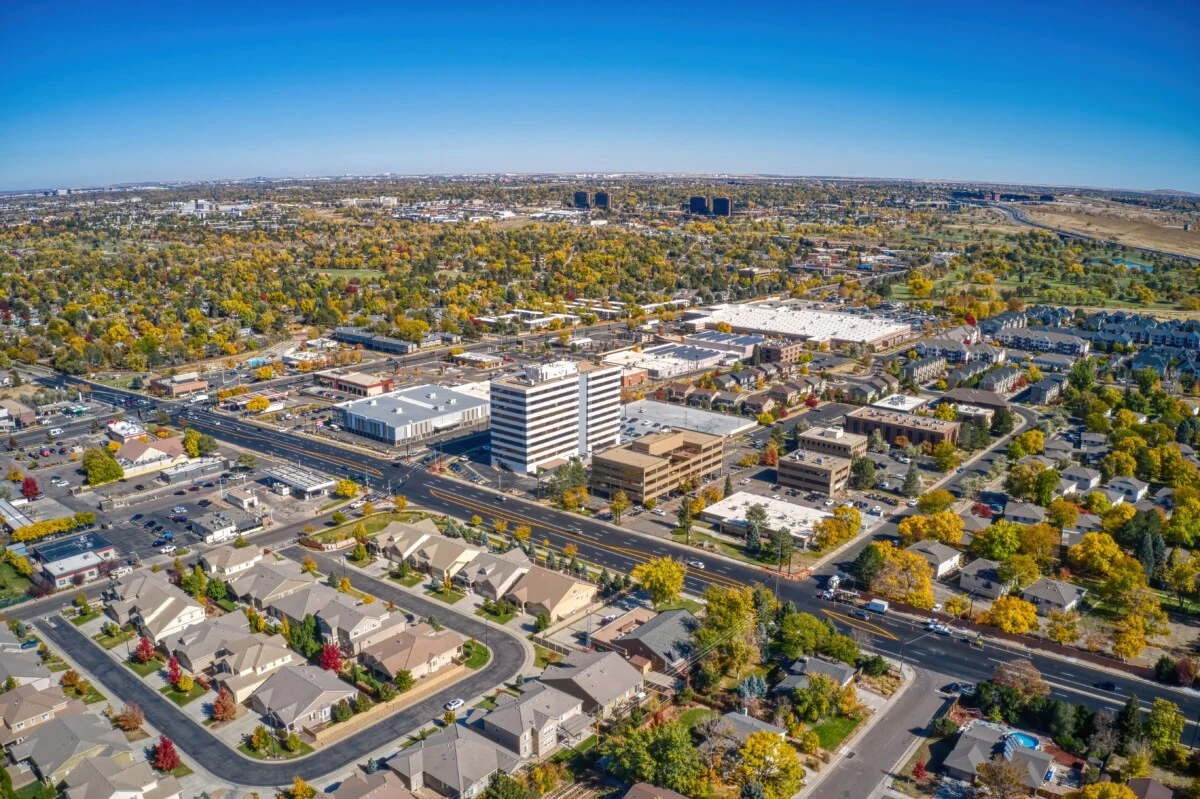
Commercial Roofers in Glendale
Commercial roofing in Glendale should begin with a documented assessment of membrane condition, seams, flashings, drainage, penetrations, and moisture before repair, coating, or replacement is selected. Glendale is barely over half a square mile, wrapped entirely inside Denver and Cherry Creek, and its density means almost every roof job here starts with an access problem before it starts with a roofing problem. Commercial Roofers of Aurora prices Glendale work with crane placement, material staging, and street closures accounted for as real line items, not afterthoughts folded into a generic square-footage number.
Small Parcels, Big Logistics Problems
Glendale's retail, restaurant, and office buildings sit on parcels tight enough that there is often no room on-site to stage a full delivery of insulation and membrane, let alone park a crane without a lane closure on Cherry Creek Drive or Leetsdale. We plan material logistics before we plan the roof spec on almost every Glendale job, sequencing smaller deliveries, coordinating with the city on any necessary right-of-way permits, and scheduling crane lifts for low-traffic windows rather than assuming a standard laydown area will be available.
That density cuts both ways on cost. Labor and logistics run higher per square foot than on an open suburban site, but Glendale's building footprints are also small enough that most reroofs here are measured in weeks, not months.
We also try to avoid scheduling major Glendale projects during the district's peak weekend entertainment hours, since crane operations and material staging compete directly with valet and delivery traffic for the same tight curb space that restaurants and bars depend on for their own business.
Restaurant and Bar Roofs Carry Heavy Exhaust Loads
Glendale's entertainment and restaurant district means a disproportionate share of its roofs carry commercial kitchen exhaust systems, grease duct penetrations, and makeup-air units running longer daily hours than a typical office building's HVAC schedule. Grease-laden exhaust air degrades membrane and flashing around those penetrations faster than ordinary rooftop conditions, and we inspect grease containment and curb condition specifically on these buildings rather than treating every penetration as a standard HVAC curb.
Hotel roofs near the CitySet development add a second category of dense penetration work, guest room RTU zones, pool mechanical, and elevator overruns, layered onto a footprint just as constrained as the restaurant buildings around it.
Cherry Creek Drainage and Roof-Level Water Management
Buildings along Cherry Creek Drive sit close enough to the creek corridor that roof drainage design matters more here than it would on a site with more surrounding grade to absorb runoff. We check that internal drains, scuppers, and downspouts are sized and maintained to move water off the roof fast during Denver's short, intense summer thunderstorms, since a roof that ponds even briefly on a low-slope Glendale building has less margin for error than a building on a larger lot with more roof area to spread the load.
Denver's summer storm pattern tends to deliver short, high-intensity bursts rather than sustained rain, and a roof drainage system sized for a gentler, longer storm can be overwhelmed in the first fifteen minutes of a Glendale thunderstorm. We size drain and scupper capacity to that burst-intensity pattern rather than to average annual rainfall.
What We Check Before Quoting a Dense-Site Job
Every Glendale estimate starts with a site walk focused as much on the street and the neighboring parcels as on the roof itself. What we look for:
- Available staging area and whether a street or lane closure permit is needed
- Crane access and overhead obstructions from adjacent buildings and power lines
- Grease exhaust and kitchen curb condition on restaurant and bar buildings
- Drain and scupper capacity relative to roof area and slope
- Shared-wall or party-wall flashing details common on tightly packed parcels
- Noise and odor restrictions tied to adjacent occupied businesses
We walk that list on every Glendale site before we write a number down, because a logistics problem discovered mid-project costs far more to solve than one priced into the estimate up front.
Mixed Ownership on Small Footprints
A number of Glendale's retail and restaurant buildings sit under condo-style commercial ownership or ground-lease arrangements, which means a roof decision sometimes needs sign-off from more than one stakeholder before work starts. We build proposals that separate cost by ownership boundary where a roof spans more than one owner's space, so each party can see exactly what portion of the job is theirs.
We have also found it worth confirming who actually holds warranty responsibility before work starts on a condo-style building, since a prior owner's roof work sometimes carries a warranty that transfers with the unit, and duplicating coverage an owner already has wastes money on both sides.
What Glendale Property Owners Want to Know
Can you work on a site with no room to stage materials?
Yes, this is close to every-day work for us in Glendale. We plan smaller, sequenced deliveries and coordinate crane windows around your building's access constraints rather than assuming a standard laydown area.
Do restaurant roofs really wear out faster than office roofs?
Around the kitchen exhaust penetrations, yes. Grease-laden air degrades membrane and sealant faster there than on a standard HVAC curb, so we inspect those areas on a shorter interval on restaurant buildings.
Will you need a street closure permit for our building?
It depends on the site. We evaluate access during the estimate and handle permitting for any lane or sidewalk closure a crane lift or material delivery requires.
How do you handle a roof that spans more than one owner's unit?
We split the proposal by ownership boundary so each party sees a clear, separate cost for their portion of the work, and we coordinate scheduling across all stakeholders before work begins.
Is Glendale's small size actually a cost advantage?
In some ways, yes. Smaller footprints mean shorter project timelines even though logistics cost more per square foot, so total project cost is often lower in absolute terms than a similar system installed on a much larger suburban roof.