Roof Capital Planning for Aurora-Area Office and Retail Portfolios
Asset managers holding office, retail, and flex buildings across Greenwood Village, Inverness, and the I-25 corridor near Meridian and Dove Valley treat roof condition as a line item, not an afterthought. We give that number the same discipline a lender or acquisition committee expects from any other capital forecast.
Roof Condition as a Line Item in Acquisition Due Diligence
Before a building trades hands, whoever's underwriting the deal wants a defensible answer on remaining roof life, not a guess. We inspect membrane condition, seam integrity, insulation moisture content, and drain capacity, then hand back a report written for an underwriting file rather than a sales pitch.
Where a roof's remaining life is genuinely uncertain, we say so and explain what a core sample or infrared moisture scan would resolve, rather than rounding to a number that looks cleaner on a spreadsheet than the roof actually supports.
Capital Reserve Planning Across a DTC and I-25 Office Portfolio
A portfolio spanning Greenwood Village office towers, Inverness flex buildings, and a Meridian campus rarely needs every roof replaced in the same fiscal year. We build a reserve schedule that spreads spend across the hold period based on each roof's actual condition, so a capital committee sees a forecast tied to inspection data instead of a flat percentage rule of thumb.
That schedule typically separates roofs into three tiers worth budgeting differently:
- Roofs needing full replacement inside the current reserve cycle
- Roofs eligible for a recover or coating that defers replacement several years
- Roofs under 10 years old needing only preventive maintenance and periodic inspection
- Roofs with drainage or ponding issues that need correction regardless of membrane age
- Roofs still under a manufacturer or seller warranty that limits which contractor can touch them
Sorting the portfolio this way usually cuts the near-term capital ask significantly compared to treating every roof as an immediate replacement candidate.
Coatings and Recover Systems to Extend Life Without a Special Assessment
On office and retail buildings where ownership wants to avoid a special assessment or a large draw against reserves, a silicone coating or a full recover system can push a viable roof several more years before a tear-off becomes unavoidable. We're direct about which roofs qualify and which ones are past that window, since recommending a coating on a roof that needs a tear-off just delays a bigger problem.
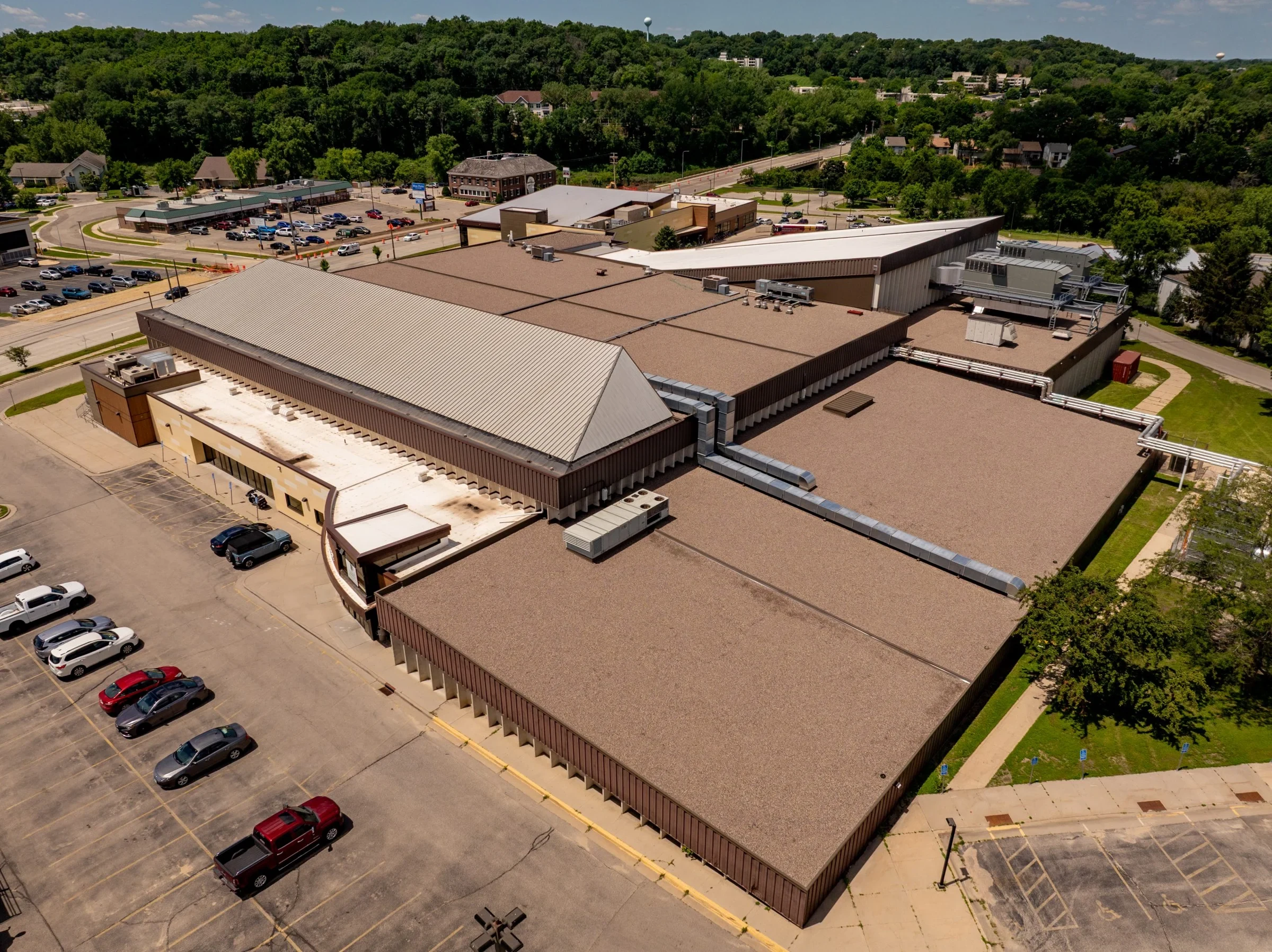
Flex buildings around Dove Valley and Inverness with lighter rooftop equipment loads are frequently good recover candidates, where a Greenwood Village office tower carrying heavier HVAC often isn't.
We put both options side by side with a cost-per-square-foot number over a 10- and 20-year window, since a coating that looks cheap today can cost more than a recover over a longer hold period if it needs reapplication twice in that span.
Coordinating Reroofs Around Tenant Lease Terms and Occupancy
An occupied office building's roof schedule has to work around lease terms, tenant improvement timelines, and sometimes a specific tenant's noise-sensitivity clause. We build the work plan around occupancy first, staging material hoists and access points to minimize disruption to ground-floor retail or lobby traffic during business hours.
For multi-tenant retail centers, we sequence work unit by unit rather than shutting down common-area access for the whole property, since a closed parking lane or blocked storefront during a reroof directly affects a tenant's sales.
Southlands and Suburban Retail Roof Portfolios
Open-air retail centers like Southlands in east Aurora carry a different roof profile than an enclosed mall or office tower: multiple smaller roof sections across pad buildings and a larger anchor roof, often with different membrane ages depending on when each building was added. We inventory these portfolios building by building rather than quoting the center as one uniform roof.
That distinction matters most at renewal time, when an owner needs to know which pad buildings are due for attention now and which can wait for the next reserve cycle.
Lone Tree's mix of corporate campuses and the retail draw around Park Meadows sits closer to a single-owner large footprint than the pad-by-pad structure at Southlands, which changes how we sequence the work. A campus with one ownership group can often absorb a larger single mobilization than a retail center with a dozen separate tenants each protecting their own storefront access.
Questions Asset Managers Ask Before Committing Capital
How accurate is a roof condition report used for underwriting?
As accurate as the inspection method behind it. A visual walk gives a general read; core samples and moisture scans give the data an underwriting file actually needs, and we'll recommend the level of inspection that matches the deal size.
Can you inspect an entire portfolio on one engagement?
Yes, and that's usually more efficient for both sides. We prioritize by property risk so the report on your highest-exposure roof is ready before we've finished walking the last building.
Do you provide reserve study numbers we can hand to our lender?
We provide the underlying condition data and cost estimates; how that feeds into your formal reserve study format is something we can align with your finance team's template.
What's the difference between a recover and a coating?
A coating seals and reflects an existing membrane that's still structurally sound. A recover adds a new membrane layer over the old one. Both extend life without a full tear-off, but they suit different starting conditions.
How do you handle roofs on properties still under a seller's warranty?
We'll review the existing warranty terms before recommending anything that could void coverage, and flag any work that should route through the original installer instead.